
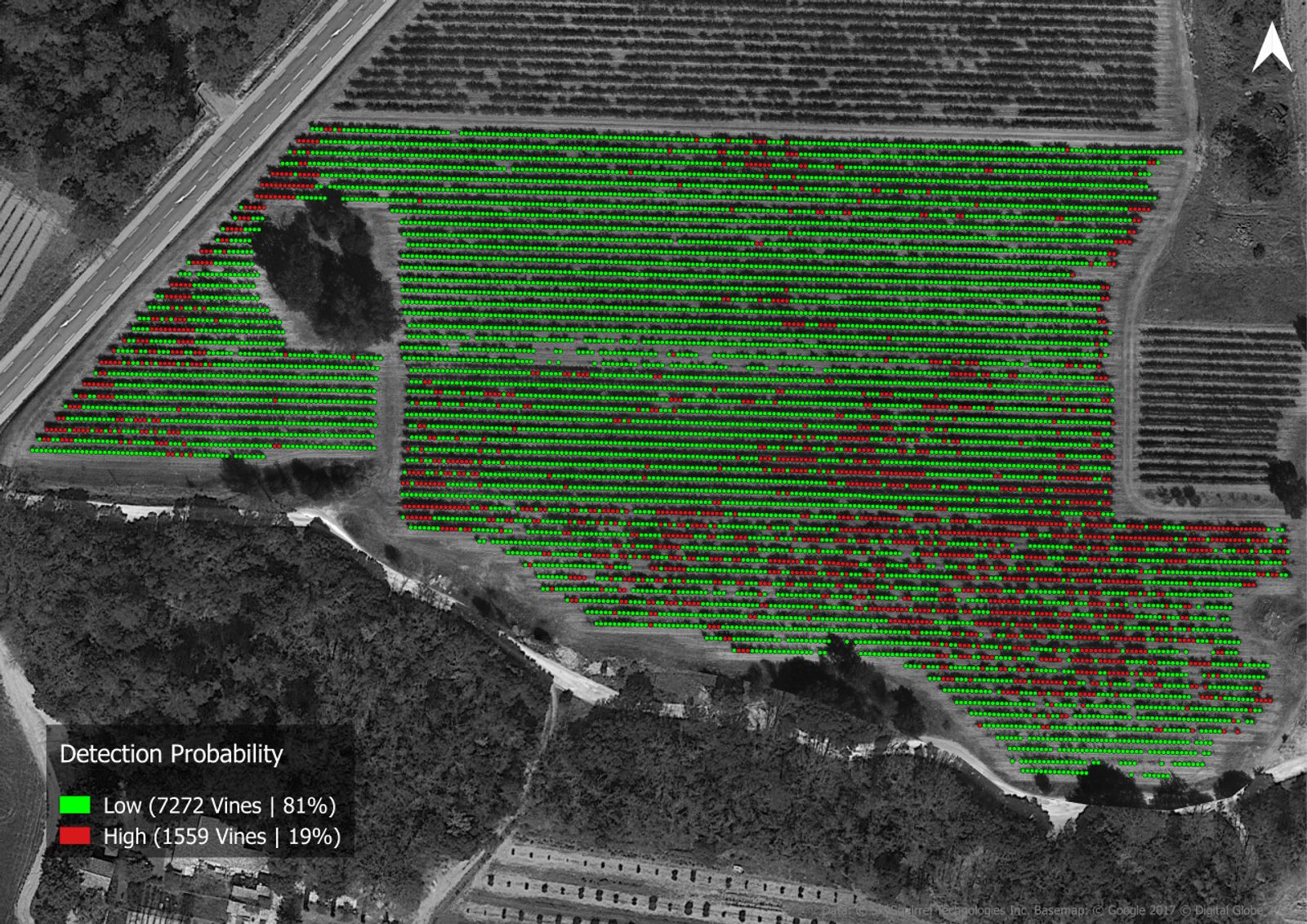
A grower looks at an NDVI map on a laptop or phone. Parts of the vineyard are green, others yellow or red. The image is clear. The question is not.
So what am I meant to do with this?
This is the moment where aerial imagery either becomes useful – or quietly gets ignored. Not because the data is wrong, but because it doesn’t yet point to a decision.
Drone and aerial imagery have become powerful tools for vineyards, but they are often misunderstood. A single flight can produce striking maps, yet those images rarely explain why differences appear or what should happen next. Used in isolation, aerial data risks becoming another layer of information without impact.
What aerial imagery is genuinely good at
Aerial imagery’s real strength is revealing where change is expressing across a vineyard.
From above, patterns emerge that are difficult or impossible to see at ground level – especially in larger or uneven blocks. These include:
- uneven canopy development
- zones of reduced photosynthetic activity
- areas responding differently to weather or management
- subtle shifts that are easy to miss when walking rows
Indices such as NDVI are best understood as proxies – indicators of greenness and photosynthetic activity, not direct measurements of vine health. In vineyards, these signals often correlate with vigour, but not always. Inter-row vegetation, cover crops, or weed pressure can sometimes inflate values, reinforcing why imagery must be interpreted with care.
When flights are repeatable and comparable – same sensor, timing, altitude – imagery becomes more than a snapshot. It shows where the vineyard is changing, not just how it looks today.
Used well, aerial imagery helps growers:
- prioritise where to walk first
- focus inspections on specific rows or zones
- spot emerging differences earlier, before they become obvious problems
In short, it narrows the search.
What aerial imagery cannot tell you
Where problems start is when imagery is asked to explain more than it can.
A map can show spatial patterns. It cannot explain causal mechanisms.
Differences in NDVI or colour may be driven by:
- soil moisture availability
- soil structure or depth
- root development
- disease pressure
- nutrition
- compaction or historic management
From above, these causes are indistinguishable.
Aerial imagery also represents a temporal snapshot. A single flight cannot reliably separate short-term noise – cloud shadow, dust, transient stress – from meaningful signal without comparison over time. This is why isolated maps so often raise questions they cannot answer.
And critically, imagery does not replace field checks. It tells you where to look, not what you will find when you get there.
Resolution matters, but it’s not the whole story
Not all aerial data is equal. Satellite imagery offers scale and frequency, but pixel sizes can be too coarse to reliably separate vine rows from soil or inter-row vegetation. Drone imagery, captured at sub-metre resolution, can resolve individual rows and even intra-row variation, and allows soil background to be filtered out more effectively. The trade-off is data volume and complexity. Higher resolution brings better spatial insight but only adds value if the imagery is processed consistently and interpreted within context.
Again, the issue is not capability – it is application.
Where aerial imagery really delivers value
Aerial data becomes genuinely useful when it is connected to longer-term signals from the ground.
For example: an NDVI map highlights a low-activity patch mid-block. On its own, that suggests water stress. But soil moisture data from capacitance probes in that zone shows consistently high moisture relative to surrounding rows. That immediately reframes the problem – from irrigation deficit to restricted root function or soil structure.
Alternatively, repeated imagery may show declining canopy activity while leaf water potential measurements remain stable, pointing attention away from water stress and towards disease or nutrient limitation.
The image shows where to investigate. Ground measurements help explain why. Together, they prevent the wrong response.
This is the role aerial imagery plays best: verification, prioritisation, and spatial context – not diagnosis in isolation.
Seeing clearly means knowing the limits
Aerial imagery is neither a silver bullet nor a gimmick. It is a powerful lens – but only when used for the job it is suited to. Its strength is showing where change is happening across a vineyard. Its limitation is that it cannot explain causes, forecast outcomes, or replace agronomic judgement on its own.
Growers who get the most value from aerial data are not those who fly most often, but those who know when to fly, what to compare, and how to connect what they see from above with what they measure on the ground. Seeing where change is happening is the first step. Turning that insight into decisions requires more than a map.
Conclusion: Maps Don’t Make Decisions – Context Does!
Aerial imagery is at its most useful when it is treated as a starting point, not an answer. It shows where change is happening across a vineyard, but it cannot explain why that change exists or what the correct response should be on its own.
The risk is not using imagery – it is mistaking visibility for understanding. Without ground measurements, historical context, and time-based comparison, even the clearest map remains ambiguous.
Used properly, aerial data reduces uncertainty by focusing attention and effort. It helps growers ask better questions, sooner, and in the right places. Turning those questions into confident decisions requires connecting what is seen from above with what is measured on the ground.
That connection – between signals and action – is where digital tools either earn their place in the vineyard or quietly fall away.