
Vineyards are built on assumptions: the climate you expect, the patterns you believe will hold, and the risks you think you can manage.
For generations, Tuscan vineyards were planted based on lived experience of slopes, aspects, soils and varieties, and of the local weather and climate patterns that shaped how vines behaved year after year. Farmers carried an intuitive understanding of when heat arrived, how storms moved through a valley, how night-time cooling worked on a particular slope, and how the landscape responded to stress. That knowledge is still valuable, but it was shaped by a climate that no longer exists.
Most of Tuscany’s vineyards were designed before the effects of climate change were fully understood, or even visible. Their layout, trellising, clone choices and water expectations reflect a cooler, more predictable era. Today, those assumptions are being stress-tested by conditions that diverge sharply from the past.
Heat is no longer an occasional disruption. It is becoming a structural feature of Mediterranean viticulture. Designing vineyards that perform under rising temperatures means thinking in decades, not seasons and using data to anticipate what the next 20 years will demand.
A warming climate: what the data shows
Over the past four decades, the climate of Mediterranean Europe has shifted faster than many growers realise. Average growing-season temperatures have risen by around 1.5 °C since the 1980s – a change large enough to alter vine physiology, ripening patterns and water demand across the region.
Data from the Copernicus Climate Data Store (https://cds.climate.copernicus.eu) and CREA Viticoltura(https://www.crea.gov.it/viticoltura-ed-enologia) illustrate this trend clearly.
In central Italy, the acceleration is especially evident. According to Copernicus and CREA, the region is experiencing:
- More days above 35 °C
- Higher night temperatures, reducing vine recovery
- Faster heat accumulation (GDD)
- More frequent and longer heatwaves
- Increased water stress, particularly in dry-farmed vineyards
These changes are already reshaping viticulture across Tuscany:
- Sangiovese ripens faster, often with sugars racing ahead of phenolic maturity.
- High, once-marginal Chianti Classico hillsides now outperform many valley-floor sites.
- Terraced vineyards retain heat late into the evening, compounding daily stress.
- Coastal zones such as Maremma face intense radiation and extended drought periods.
These are not future projections; they are observable realities. They influence pruning strategy, canopy design, irrigation choices, harvest timing and even the long-term suitability of certain blocks. The vineyards that succeed will be those designed not for the climate of 1990 but for the climate of 2040. Most of the adjustments that improve heat resilience do not require replanting. Many of the highest-impact changes, including canopy management, shading, irrigation timing and soil management can be made within existing vineyards and often deliver the greatest gains.
Designing for the vineyard of tomorrow
Orientation and topography
Heat resilience begins with vineyard architecture. Slope, elevation, aspect, airflow and row direction determine how vines interact with sunlight and temperature. In Tuscany, where the landscape is complex and often terraced, these factors matter:
- North–south rows provide balanced light but expose the western side of Sangiovese to harsh afternoon sun.
- On steep Chianti slopes, a north-east orientation can reduce heat accumulation late in the day.
- Terraces often trap warm air on still evenings – an effect invisible without microclimate measurement.
- Valley floors retain heat, limiting night-time vine recovery.
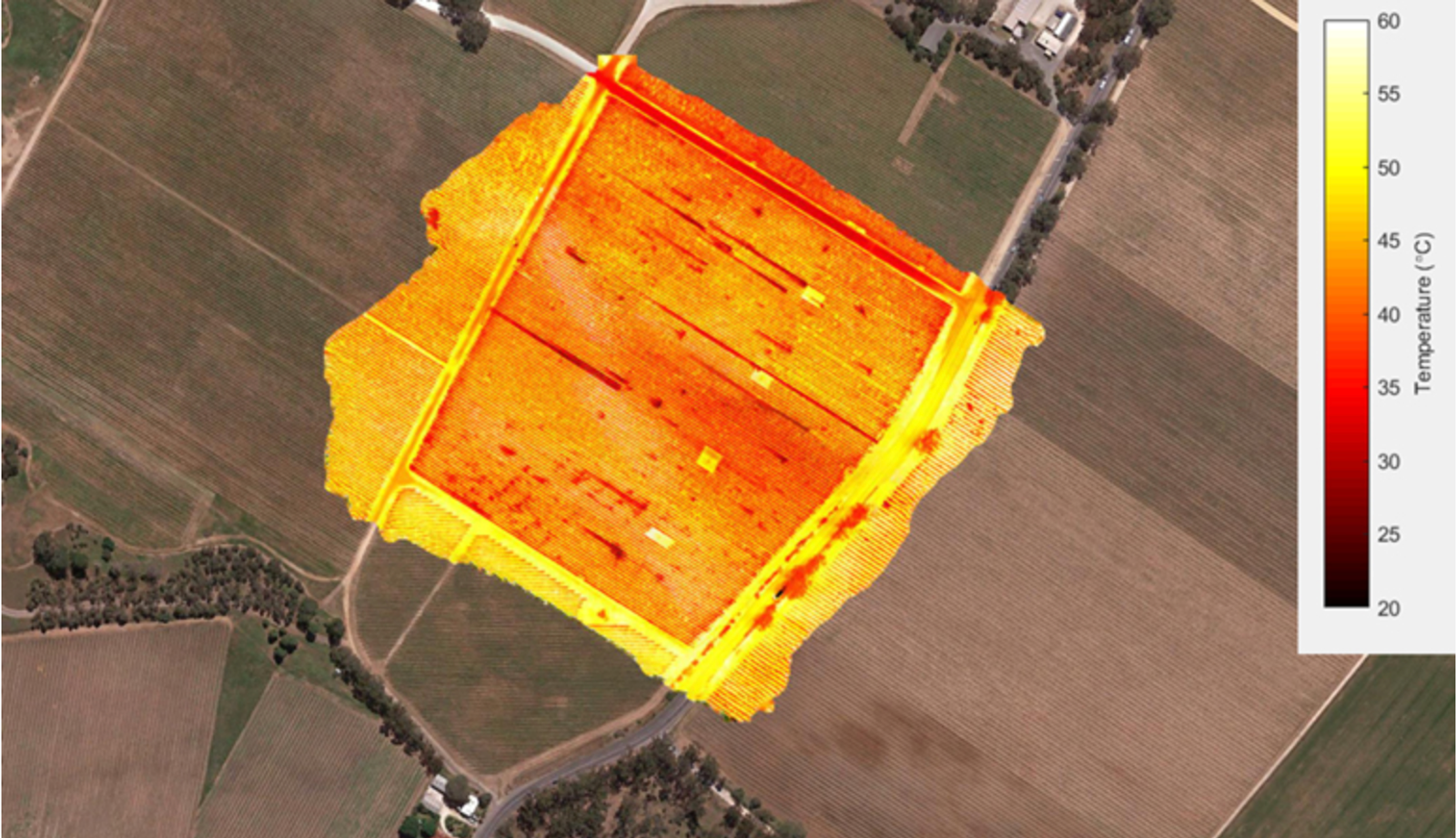
Mapping temperature and radiation using canopy sensors, drone thermography or micro-weather stations reveals consistent heat-stress zones – insights that would have been impossible when many vineyards were planted. This intelligence guides smarter replanting, block redesign and targeted intervention.
Canopy systems built for heat
Future canopy systems must balance light, airflow and protection, especially for heat-sensitive varieties such as Sangiovese. Adaptations now proving valuable include:
- Higher trellising, improving airflow and reducing radiant heat load.
- Split or open canopies (Lyre, GDC) that disperse heat more effectively.
- Selective leaf retention on the west-facing side to shield fruit from peak afternoon temperatures.
- Adaptive canopy frameworks allowing growers to adjust density dynamically as the season evolves.
Technology earns its value by showing which blocks need these adjustments.
Drone maps, for example, can reveal a terrace that consistently runs hotter long before visible symptoms appear, enabling growers to adjust canopy structure only where it matters.
Varieties and rootstocks for a warmer future
Varietal and rootstock choices represent one of the most powerful long-term climate adaptation levers and one of the slowest to change, making data essential.
Key considerations include:
- Heat-tolerant varieties such as Aglianico, Grenache and Montepulciano maintain balance under extreme heat.
- Sangiovese shows marked sensitivity to sunburn and rapid sugar accumulation.
- Deep-rooting rootstocks like 110R and 140Ru maintain vine water status during prolonged drought.
- Research from INRAE and CREA shows that optimal rootstock–variety combinations can reduce canopy temperature by 1–1.5 °C under identical conditions.
AI-assisted modelling can help growers simulate how planting choices made today will perform in future climate conditions.
Water management and infrastructure
Water, rather than heat alone, is often the true limiting factor. Many Tuscan vineyards are dry farmed, relying on soil depth and structure to buffer vines through the hottest weeks. In cooler decades, deep winter rains were typically enough to recharge the soil profile and carry vines into summer with a stable reserve.
But as winters become drier and more erratic, and as spring temperatures rise earlier in the season, these reserves are depleted sooner. The natural buffers that once protected vineyards through July and August are now under growing pressure.
In this context, growers increasingly need a clearer picture of how water moves through the soil – how much winter recharge remains, how quickly it is being used as temperatures climb, and which blocks are likely to reach stress first. Understanding this hidden dynamic allows irrigation, canopy adjustments and other interventions to be timed with far greater precision.
Several practices and technologies now play a key role in this more data-aware approach:
- Soil moisture probes provide continuous depth profiles, offering early warning when the profile begins to dry faster than expected.
- Pre-irrigation before heatwaves (where possible and permitted) helps stabilise vine water potential ahead of critical events, reducing the risk of shrivel and sunburn.
- Pressure-compensated drip irrigation systems deliver uniform water across slopes and terraces, reducing variability in vine stress across complex landscapes.
- Shade nets can lower canopy temperatures by 2–4 °C, protecting fruit and slowing water loss during extreme heat.
- Reflective ground covers reduce radiant heat from the soil surface, moderating the microclimate around clusters.
- Building soil organic matter increases water-holding capacity in thin galestro soils, helping vines maintain function deeper into the season.
Used together, these tools help prevent both under- and over-reaction. Knowing when not to irrigate saves water, energy and labour, while knowing when to irrigate early can prevent crop loss entirely.
Heat also influences disease behaviour in ways that matter for long-term planning. Extended hot, dry periods generally suppress downy mildew but can favour powdery mildew, particularly when vines are under stress. When intense heat is followed by rainfall, infection risk can increase rapidly. Integrating heat-adaptation and disease-risk awareness ensures that canopy and irrigation decisions support both resilience and plant health.
From data to design: where technology becomes practical
Vineyards rarely behave uniformly. Terraces, slopes and changes in soil and exposure mean that two blocks a few metres apart can respond very differently to heat. Without data, these differences stay hidden. With data, they become the basis for smarter design and more confident decision-making.
This is where technology can create value for farmers, not by replacing generations of experience, but by revealing the patterns that experience alone can’t reliably detect.
Aurelia is beginning to bring these layers together through Early Access Partnerships, working with growers to gather soil, canopy and microclimate data and to map how different blocks respond to heat across the season. As these datasets grow, we are developing AI models that can analyse recurring patterns, anticipate emerging stress and explore long-term scenarios that would be difficult to evaluate manually. The aim is not to replace intuition but to support growers with clearer, evidence-based insight as they design vineyards for a changing climate.
This combined view will help growers understand:
- where heat stress appears earliest
- which terraces consistently run hotter
- where water availability is likely to run short
- which blocks would benefit from shading or canopy adjustments
- where replanting, row orientation or rootstock changes will matter most
The decisions remain in the grower’s hands, but the technology provides is the clarity, foresight and confidence to act at the right moment, and to design vineyards around the climate they face now and, in the future, not the one they remember.
The economics of resilience
Heat adaptation fundamentally an agronomic and an economic issue. In all wine growing regions where vintage quality, labour availability and block-level variability all impact profitability, heat introduces a layer of volatility that growers cannot afford to ignore.
The costs show up in many forms:
- sunburn and shrivel, particularly on west-facing Sangiovese blocks
- mistimed canopy work, either rushed or repeated unnecessarily
- avoidable irrigation cycles, especially on terraces and slopes
- uneven or accelerated ripening, complicating harvest logistics
- labour inefficiencies, as crews adjust plans around heatwaves
- emergency interventions, often at the highest cost and lowest impact
A microclimate-led approach reduces these losses by making timing and prioritisation far more precise. The value comes from clarity, not complexity:
- Falling technology costs: sensors, connectivity and drone imaging have all become significantly cheaper and easier to deploy, lowering the barrier to adoption.
- Avoided losses: a single heat event causing a 5–10% reduction in a Sangiovese block can exceed the cost of a basic monitoring and analysis setup.
- Precision in operations: one prevented irrigation cycle, or one canopy adjustment done at the right moment rather than the wrong one, can save hundreds of euros per block.
- Protection of wine quality: heat-accelerated ripening affects alcohol balance, phenolics and harvest decisions; better data reduces the risks of picking too early or too late.
- Long-term compounding value: the earlier growers adopt microclimate-aware design and management, the more consistent and predictable the vineyard becomes over time.
In a landscape where conditions are changing faster than vineyards can naturally adapt, resilience is not an overhead – it is an investment in stability, predictability and long-term performance. The growers who see the economic value of heat adaptation early will be the ones who carry its benefits across the next two decades.
Conclusion
- Designing for heat means building vineyards that perform through extremes rather than merely survive them. Microclimate data, sensors and predictive models provide a level of clarity and foresight that traditional observation alone can no longer guarantee, particularly in Tuscany where diverse terrain and soils create intense variation from one block to the next.
- Technology does not replace intuition. It strengthens it by revealing patterns that help growers intervene earlier, plan more effectively and maintain quality more consistently across variable seasons.
- The climate is changing. The vineyards that thrive will be those deliberately designed, managed and continually refined for the conditions ahead rather than the conditions of the past.